
Building in Bend's High Desert: What the Climate and Land Demand
Most building advice you'll read online was written for somewhere else. Milder climates, deeper topsoil, lower elevation, less sun.
Bend is not somewhere else. We sit at roughly 3,600 feet on the dry side of the Cascades — high desert, with everything that implies: intense ultraviolet light, dramatic temperature swings, real winters, volcanic soil, wildfire exposure, and some of the best building sites in the country perched on slopes with views to match.
After twenty years of building custom homes in Bend, we've learned that the climate and the land aren't footnotes in the design process. They're co-authors. Here's how they shape the decisions we make on every project.
The 40-Degree Day
Bend regularly swings 35 to 40 degrees between an afternoon high and the following morning's low — sometimes within the same day. A July afternoon at 90 can be a July night at 50. That's hard on materials, because everything in your home expands and contracts with temperature, and the wider the swing, the more movement your assemblies have to absorb.
This shows up in the details most people never see: how siding is gapped and fastened, how large window and door units are flashed and allowed to move, how exterior trim joints are designed so they don't telegraph every seasonal cycle. Materials that perform beautifully in Portland's gentle range can open up, cup, or crack here — so detailing for movement, and choosing materials that tolerate it, is something we think about on the sun-and-temperature-exposed parts of every home.
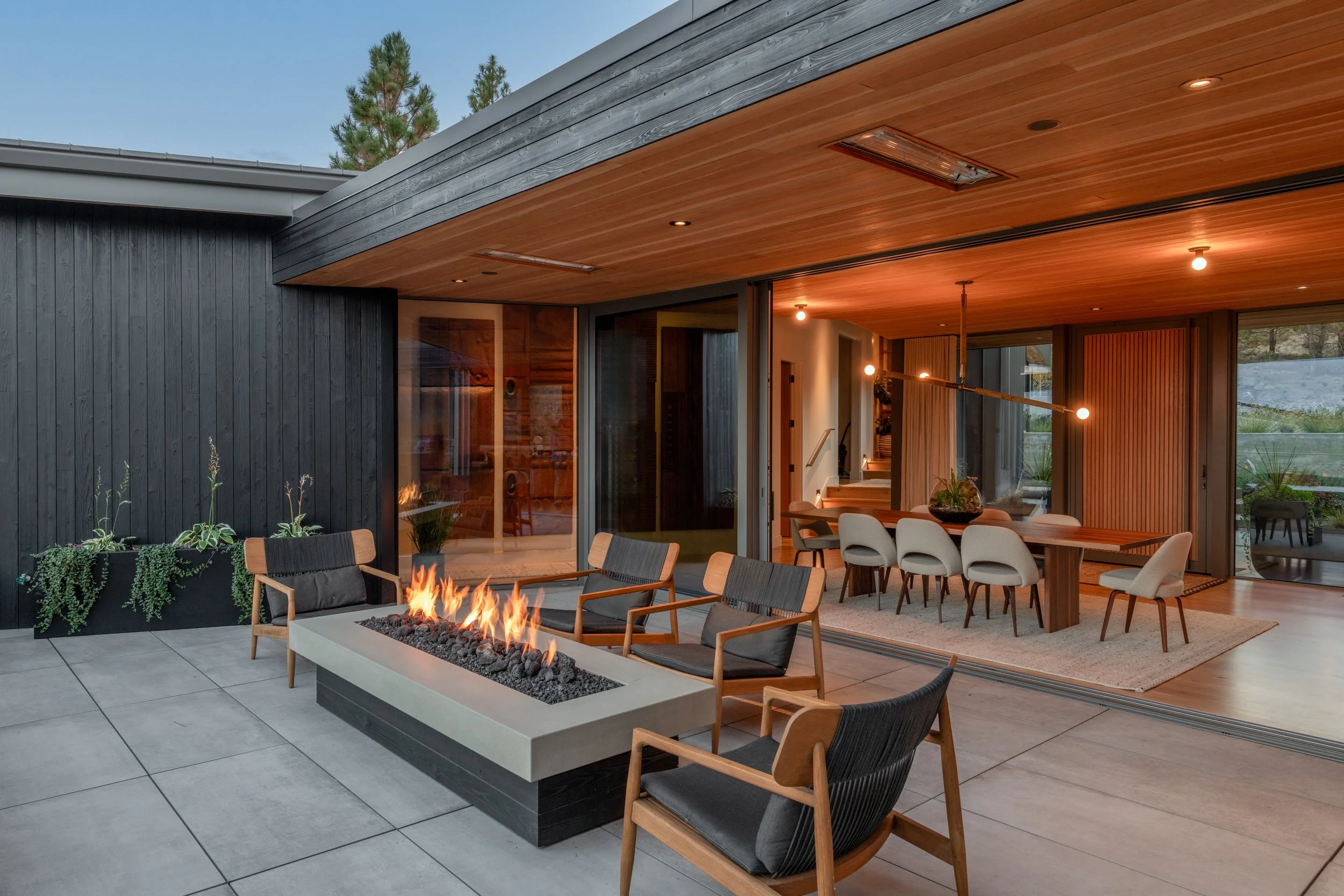
The swings also drive mechanical design. A high-performance envelope — serious insulation, careful air sealing, quality glazing — does more for comfort in Bend than oversized equipment ever will, because it dampens the daily swing instead of fighting it room by room. (Building well here takes time, too — a custom build typically runs 16 to 24 months from groundbreaking, with another 6 to 12 months of design and permitting before that. The high desert rewards patience.)
Building through winter is its own discipline. When the schedule runs cold — and in Bend, part of most builds does — we use cold-weather practices: heated enclosures, proper concrete curing, and sequencing work around the weather so a January pour performs like a July one. Done casually, cold-weather work is where quality quietly erodes; done right, it keeps a project moving without compromise.
Sun That Doesn't Quit
Three hundred days of sun a year is why people move here. It's also roughly 25 percent more UV intensity than at sea level — thinner atmosphere, drier air, less of the haze that softens sunlight in wetter climates.
The sun is a design asset and a maintenance liability at the same time. On the asset side: passive solar orientation genuinely works here. Get the glazing and overhangs right and a home warms itself on winter days and shades itself in July. We think about orientation during pre-construction, before the design is locked — it's free performance if you plan for it and expensive to retrofit if you don't.
On the liability side: south- and west-facing finishes take a beating. Stains, sealers, fabrics, decking, even some window components age on an accelerated schedule on the sun-struck sides of a Bend home. We spec and detail those elevations differently because of it — the materials that go on the south and west faces of a home here aren't always the same ones we'd use on the north, and the maintenance expectations aren't either.
The practical takeaway for anyone planning a build: ask how your builder details the south and west elevations differently than the north. If the answer is "we don't," the sun will eventually answer for them.
Snow, and What the Roof Carries
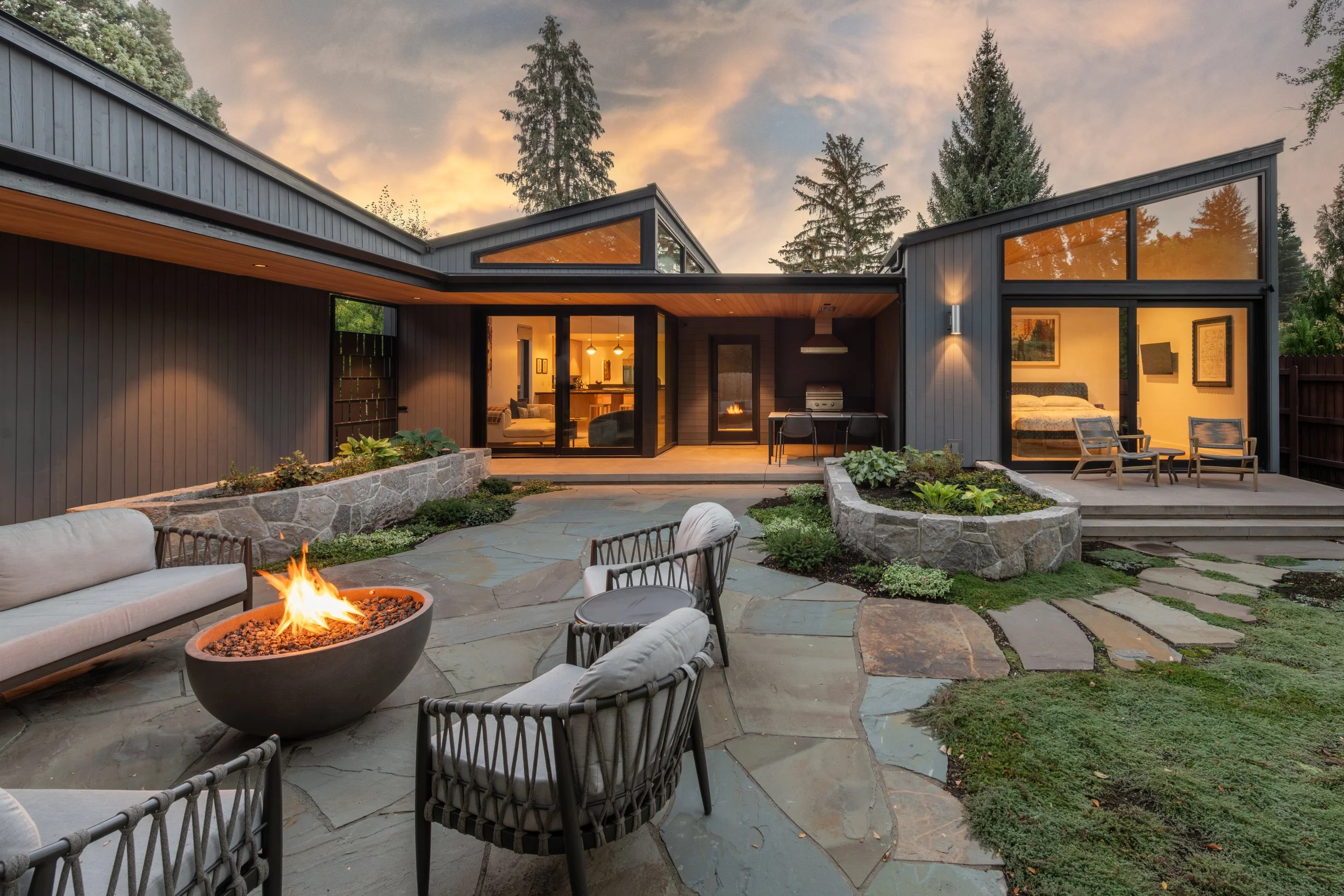
The same elevation that gives Bend its sun gives it real winters, and snow load is a structural input here, not an afterthought. Every roof we build is engineered to carry the snow our climate actually delivers — which is exactly why you see so many flat and low-slope roofs on modern Bend homes. They're not a liability when they're designed for the loads; they're a deliberate architectural choice backed by structural engineering sized for Central Oregon. A flat roof in Bend isn't a flat roof borrowed from a milder climate — it's a high-desert roof that happens to be flat.
Where snow shapes the design is in the details around the structure. Roof form determines where snow sheds and where it shouldn't — you don't want a slope dumping a winter's accumulation over an entry, a walkway, or a gas meter. Valleys and roof-to-wall transitions get detailed so meltwater and sliding snow go where you've planned for them. Decks, covered outdoor spaces, and outbuildings get the same load consideration as the house. None of this constrains good design — it's simply part of designing well here, and a builder who's worked through twenty Central Oregon winters has internalized where the snow wants to go before it ever falls.
Fire Is Part of the Conversation Now
We build in and around the wildland-urban interface, and pretending otherwise doesn't serve anyone. Wildfire risk shapes Oregon code, insurance markets, and — done right — design decisions that don't compromise the home's beauty at all.
The fundamentals: ignition-resistant roofing (one reason standing-seam metal is everywhere in modern Bend architecture — it earns its look), ember-resistant venting, careful detailing where decks and fences meet the house, and defensible space planning that treats landscape as part of the fire strategy rather than an afterthought. On some sites, the wildfire overlay also affects what's required for access, water supply, and materials.
None of this is exotic anymore — it's simply competent building in Central Oregon. The homes we build are designed to meet it without looking like bunkers.
As of May 15, 2026, a lot of this moved from best practice to building code. The City of Bend adopted Section R327 of the Oregon Residential Specialty Code, which sets home-hardening requirements for newly constructed detached homes and accessory structures — noncombustible or ignition-resistant materials for roofing, gutters, windows, vents, and siding. It applies to new residential permit applications submitted on or after that date, and notably it does not apply to additions or renovations of existing homes. The requirement was already in effect in Sisters and unincorporated Deschutes County, so Bend's adoption brings the region onto a more consistent standard. For new construction, the practical effect is that wildfire-resilient detailing isn't a premium upgrade to discuss — it's the baseline we're building to, and we design it in from the start.
The Ground Fights Back
Bend sits on volcanic geology. Depending on the site, "excavation" can mean pleasant sandy loam — or it can mean rock hammering through basalt for foundations, utility trenches, and septic systems.
This is one of the biggest cost variables between two otherwise identical homes on different lots, and it's why we walk sites and study geology before anyone falls in love with a floor plan. A site evaluation during pre-construction — sometimes including test pits — tells us what the ground will and won't give us, and lets us budget honestly instead of discovering a five-figure surprise at the bottom of the first trench. It's a major reason what it costs to build here varies so much from lot to lot.
Where you build matters here, too. Bend is notoriously rocky, and some areas are rockier than others — Awbrey Butte in particular is known for it, where excavation routinely means hitting rock. Other parts of town, like the Tetherow and Shevlin Commons areas, tend to turn up less. It's not a hard rule — geology varies lot to lot even within a neighborhood — but it's the kind of local pattern worth knowing before you commit to a site, because it can swing your sitework budget meaningfully one direction or the other.
Sloped Lots: The Views Are Earned
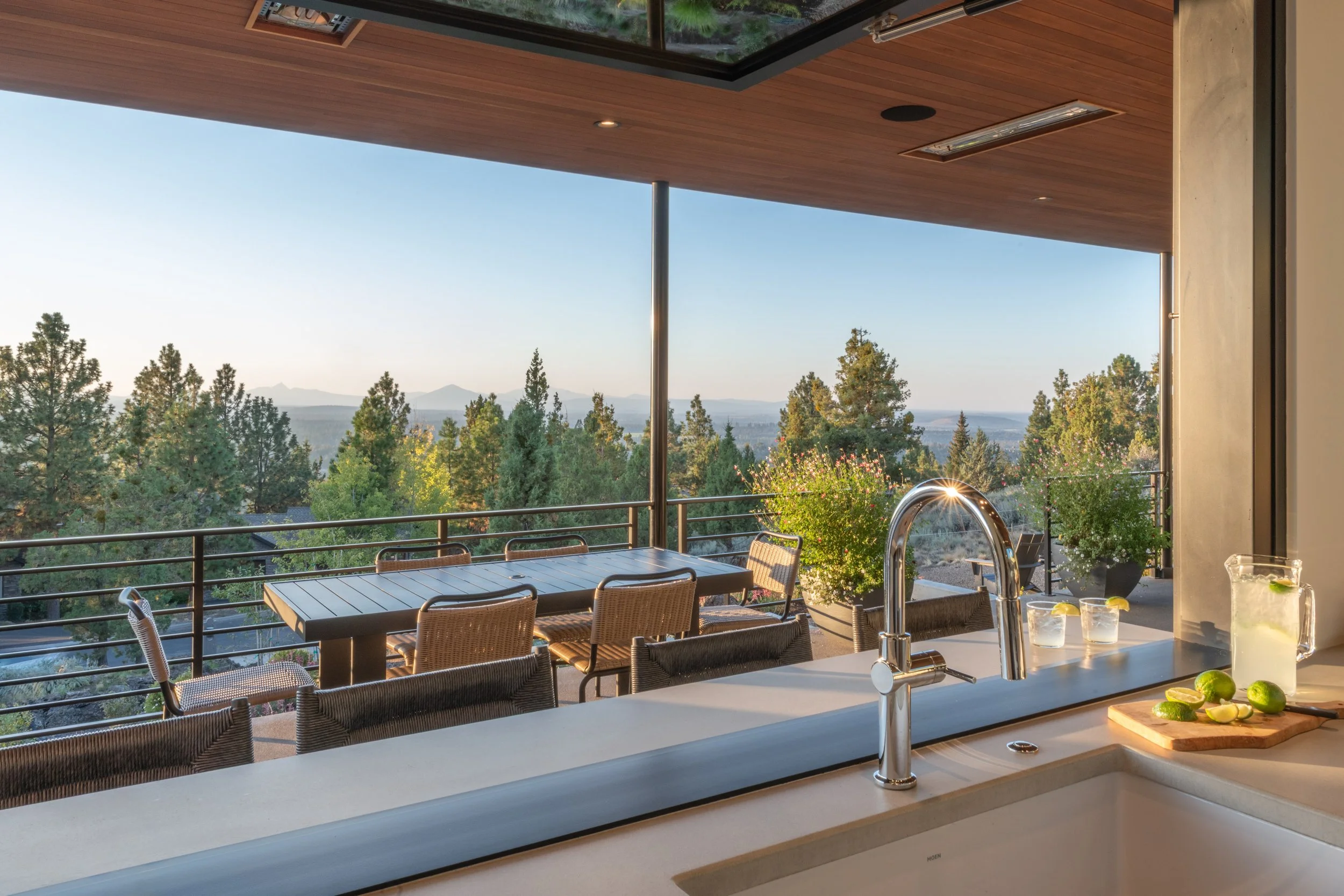
The best views in Bend — Cascade peaks, river canyon, golf course, city lights — overwhelmingly belong to sloped lots. There's a reason: flat land got built first, and the terrain that makes a site dramatic is the same terrain that makes it complex.
Slopes are some of our favorite sites to build on, and they reward honest planning. Stepped foundations and daylight basements turn grade change into architecture — lower-level guest suites that walk out to the landscape, main levels that float at treetop height. But slope also means engineered retaining, drainage designed for spring melt, driveway grades that work in January, and structural work you'll never see in the finished photos.
The mistake we see is treating a sloped lot like a flat lot with a view premium. The view premium is real — so is the construction premium, and a builder should be able to articulate both before you buy the lot, not after. You can see how we've handled steep and view-driven sites in our portfolio.
The Dry Air You Live In
High desert means dry — and not just outside. Interior humidity in a Bend home can run far lower than people expect, especially in winter with the heat running, and that has real consequences inside the walls and out. Wood moves: flooring, millwork, solid-wood doors, and fine cabinetry all respond to low humidity, which is why acclimating materials properly before installation and detailing for movement isn't optional here — it's the difference between a panel that stays tight and one that opens a gap by February.
It's also a livability point most builders never raise. Very dry indoor air affects comfort, and on higher-performance homes — where a tight envelope means less uncontrolled air exchange — whole-house humidification becomes worth a real conversation rather than an afterthought. The same dryness that protects against some climate problems creates a comfort question worth designing for.
One practice this drives for us: we acclimate materials on site before they go in. Letting wood — flooring, millwork, and the like — come to equilibrium with the actual conditions of the home before installation is how you keep a floor tight and a panel flat through the seasons, rather than watching gaps open up the first dry winter. It's an easy step to skip when a schedule is tight, and it's exactly the kind of step we don't.
Built for Here
Every one of these factors — the temperature swings, the sun, the snow, the fire code, the rock, the slopes, the dry air — is manageable. Most of them, handled early and honestly, become advantages: the sun heats your home, the slope gives you a daylight basement, the right envelope keeps you comfortable through every swing.
What they don't tolerate is a generic approach. The high desert is specific, and the homes that age well here were built by people who respect that specificity.
If you're thinking about building a custom home in Bend, that's the conversation we'd love to have — about your site, your sun, your slope, and what the high desert will ask of your home.
Copperline Homes has been building custom homes in Bend and Central Oregon since 2004. We specialize in high-end custom homes built on relationships, intention, diligence, and innovation. Let's talk →